





(876) 619-7392

Give us a call

info@jseza.com

Send us a message

Government of Jamaica

ISO 9001:2015 CERTIFIED

Government of Jamaica 

ISO 9001:2015 CERTIFIED

Select the form you wish to complete

June 5, 2024

Jamaica’s First Floating Dock Arrives

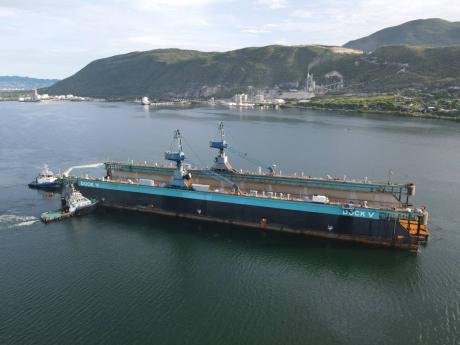
GERMAN SHIP Repair Jamaica Limited (GSRJ), a private joint venture of German, Turkish and Jamaican investors, has welcomed its first floating dock to Jamaica. The 215- metre-long Panamax-size dock arrived in Kingston on August 24. It was towed across the Atlantic by the deep-sea tug Titan from its previous home port in Bremerhaven, Germany. The dock is moored at its new home port at the GSRJ shipyard in Kingston Harbour, where it will be commissioned in the weeks ahead. Since arriving, the floating dock has been registered with the Jamaica Ship Registry, which is administered by the Maritime Authority of Jamaica (MAJ), and renamed from Dock V to JAM-DOCK 1. The GSRJ shipyard has been approved as a Special Economic FreeZone under the Jamaica Special Economic Zone Authority and has been granted all required environmental permits from the National Environment and Planning Agency. Colonel (retd) Martin Rickman, chief executive officer of GSRJ, said, “We are extremely happy to see this multimillion-dollar project finally culminating in this historic arrival of the first dock to be commissioned in Jamaica. This provides a golden opportunity for local and international vessels to be repaired in Jamaica. This will lift Jamaica’s profile in the international maritime sphere. We already have international vessels lined up for repair in the newly arrived floating dock.” In the meantime, additional local and international skilled staff are being recruited for the shipyard operations. This new industry within Jamaica will generate job opportunities for young Jamaicans in highly skilled technical jobs with international certification. The first Jamaicans who successfully graduated from GSRJ’s Dual Apprenticeship Programme, supported by the HEART/NSTA Trust and the Caribbean Maritime University, have been employed by GSRJ. The new GSRJ shipyard is expected to commence operations in the final quarter of 2023. In 2015, with funding from the Commonwealth Secretariat, the Maritime Authority of Jamaica commissioned a study, ‘Ship Repair in Jamaica’, to demonstrate Jamaica’s strategic position to viably manage and operate a dry dock for large cargo vessels. Rear Admiral (retd) Peter Brady, director general of the MAJ, said, “It is very gratifying, after so many years of planning and organising, to see the first floating dock arrive and be made ready for operation within the next few months.” The floating dock has a lifting capacity of 20,000 tonnes and is capable of dry-docking most commercial ships that visit Jamaica.

Read More »

Jamaica Pushing Forward With Its Logistics Hub project

Jamaica is pushing forward with its plans to become a global logistics hub and is anticipating many economic benefits from the endeavour. The push is being made by Industry, Investment and Commerce Minister Aubyn Hill, who says Jamaica stands to benefit significantly from the country’s bid to become a global logistics hub through the expected investments in special economic zones (SEZ) being developed across the island. SEZs are areas within a country that are created to facilitate rapid economic growth, by leveraging tax incentives as a way of attracting foreign investment and technological advancement. Logistics services are strongly associated with trade expansion and export diversification. Citing the example of countries such as Singapore, Israel and Qatar, with relatively comparable populations but significantly higher gross domestic product (GDP) per capita than Jamaica, Hill argued that Jamaica cannot attain economic wealth by limiting output and markets. He said the initial investment from local businesses to facilitate the recommended activities, paired with existing incentives offered through the Jamaica Special Economic Zone Authority (JSEZA), plays a part in making Jamaica attractive to international investors. From June 13 to 17, Jamaica will host international investors and freezone operators at the World Free Zones Organization’s Annual International Conference and Exhibition in Montego Bay, St James, with the aim of securing investments for the country. Ramping up logistics services The minister cited the need for ramping up services in logistics, noting “we (Jamaica) need to export a lot more, but it’s important that we export not just goods but also services. What local businesses must do, if we are going to change from three million people with a small per-capita GDP to three million people with a rich per-capita GDP, is that people who trade must now look to invest in our country to manufacture, build, package, repackage, assemble things and provide services that we sell to the world”. Gary Scott, acting chief executive officer of the JSEZA. For his part, Gary Scott, acting chief executive officer of the JSEZA, highlighted that linkages established through the Authority will ensure that the local economy benefits as a result of the incentives provided to the multi-national companies. He explained that when these multi-national corporations are operating from Jamaica, they are purchasing certain goods and services from the local economy. As such, the incentive scheme that the JSEZA established under the Special Economic Zone Authority removes things like general consumption tax (GCT). According to the JSEZA acting CEO, “it is not because [we want] to not have zone operators pay GCT; it is to encourage purchasing more of the goods and services from the domestic territory. So, what we are ensuring is the building out of linkage programmes that will allow for the companies in the zones to interact more freely with companies outside of the zone and purchase goods and services”. Post-pandemic opportunities In the meantime, Scott pointed to post-pandemic opportunities, saying Jamaica has been presented with the opportunity to maximise on pharmaceutical supply chain needs, which were heightened during the COVID-19 pandemic. “From what we have heard, there are a number of investors worldwide… that are looking for their next location to establish their ability to provide supplies and support to the largest consumer markets, which are the North American and South American markets,” Scott noted.

Read More »